
Will AI Replace Bank Employees? Artificial Intelligence (AI) is changing the game across industries worldwide. The banking industry is no different. Banks are rapidly adopting technology, from AI-driven chatbots that answer customer queries to advanced fraud-detection systems that analyze millions of transactions in real time to improve efficiency and reduce costs.
As AI becomes more intelligent, many workers are asking an important question: Will AI replace bank employees by 2030?
In short, the answer is no, not precisely. AI will automate many routine and repetitive tasks, but human expertise, judgment, and relationship-building skills will remain essential in banking. The future will probably be one in which humans and AI collaborate, not compete.
In this article, we’ll explore whether AI will replace bank employees by 2030, which jobs are at greatest risk, which positions will remain in demand, and what banking professionals can do to stay relevant in the age of AI.
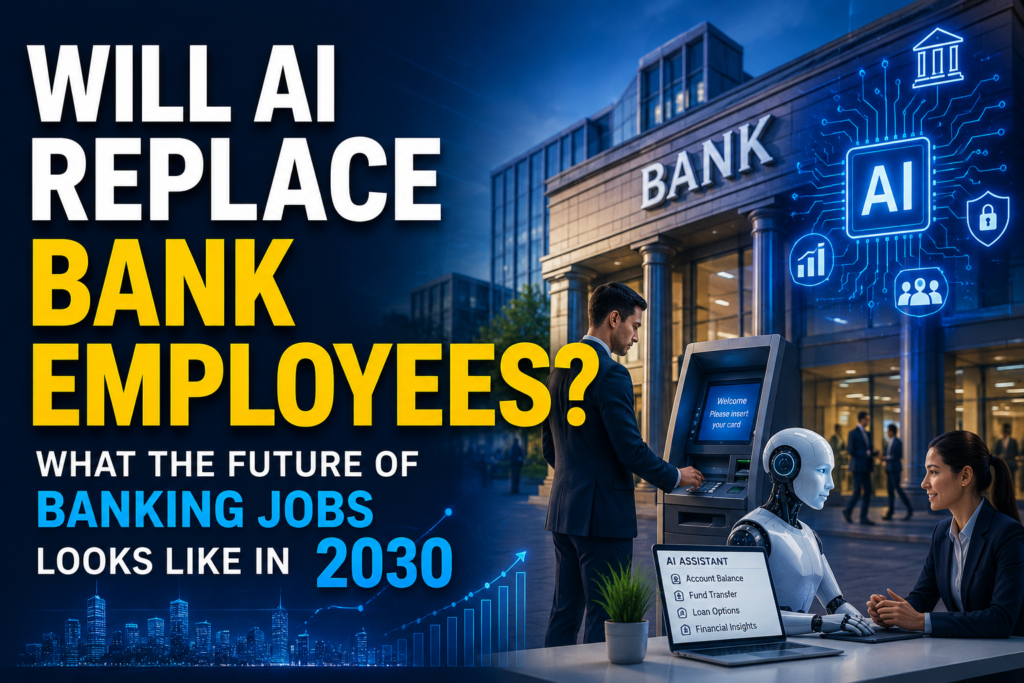
Why Banks Are Investing Heavily in AI
The banking sector handles large volumes of data daily. AI enables financial institutions to process this data faster and more accurately than traditional systems.
Banks are applying AI to:
- Fraud detection and prevention.
- Automation of customer service
- Credit risk analysis
- Personalized financial guidance
- Processing loans
- Regulatory compliance monitoring
- Predictive Analysis
According to McKinsey, AI could generate up to $1 trillion in additional value annually for the global banking industry, making it one of the most impactful technologies in financial services today.
This change is also accelerated by the rising penetration of digital banking, mobile payments, and automated financial services.
The growing adoption of digital banking, mobile payments, and automated financial services is accelerating this transformation.
Will AI Replace Bank Employees
But experts believe the rapid rise of artificial intelligence will not replace all bank employees.
AI is expected to do, instead:
- Automate repetitive tasks
- Increase operational productivity
- Help with decision-making
- Improve customer experiences
- Create new jobs in the tech sector
Much of banking is about trust, empathy, negotiation, and subtle judgment, where humans still beat machines.
The future of banking is about changing the way work gets done, not replacing employees.
10 Banking Jobs Most Likely to Be Automated by 2030
“There are some jobs in banking that are repetitive, rules-based, and automatable.
1. Bank Teller
Bank tellers already have been hit hard by:
- Internet Banking
- Banking applications
- Self-service kiosks
- ATM’s
As digital banking adoption increases, the World Economic Forum lists bank tellers among the fastest-declining occupations.
2. Data Entry Specialists
“AI-powered systems can process and organize customer information much more efficiently than manual methods.
Tasks such as:
- Customer onboarding
- Form verification
- Transaction processing
are increasingly becoming automated.
3. Basic Customer Service Representatives
AI chatbots and virtual assistants can now handle:
- Account balance inquiries
- Transaction history requests
- Password resets
- Frequently asked questions
This reduces the need for large customer support teams handling routine requests.
4. Loan Processing Clerks
AI can rapidly evaluate:
- Credit history
- Income documents
- Risk factors
- Eligibility criteria
As a result, the loan approval process is speeding up and becoming less reliant on human review.
Banking Jobs AI Can’t Easily Replace
Some jobs will change with automation. But lots of banking careers are based on uniquely human skills.
Relationship Managers
Corporate clients and high-net-worth individuals value the trusted relationships and personalized human relationships that managers offer:
Human relationship managers provide:
- Financial guidance, strategic
- Complex problem-solving
- Emotional intelligence
- Establishing long-term relationships
These capabilities remain difficult for AI to replicate.
Financial Advisors
Investment decisions often involve:
- Personal goals
- Risk tolerance
- Market uncertainty
- Behavioral factors
Clients frequently prefer to discuss significant financial decisions with experienced professionals rather than relying solely on algorithms.
Risk and Compliance Professionals
Although AI assists with compliance monitoring, humans are still needed to:
- Interpretation of regulations
- Look into rare instances
- Use ethical judgement
- Handle complex risks
Bank executives.
Leadership demands:
- Strategic thought
- Organization management
- Communication with stakeholders
- Business innovation
These duties are still very much reliant on human expertise.
How AI is creating new banking jobs
Contrary to popular belief, AI is not just taking away jobs; it is also creating brand new career paths.
By 2030, demand is expected to rise for professionals specializing in:
AI and Machine Learning
Banks increasingly require experts who can:
- Develop AI models
- Train machine learning systems
- Improve predictive analytics
Data Science
Data scientists help financial institutions uncover insights from vast amounts of customer and market data.
Cybersecurity
Digital banking is on the rise, making cybersecurity more important.
Organizations need experts who can:
- Prevent cyber attacks.
- Keep customer data safe
- Monitor digital threats
Ethics and AI Governance
Banks need to make sure AI systems remain
- Clear
- Quite
- Compliant
- Unbiased (and damagingly)
It is creating demand for AI governance professionals and specialists in ethics.
Skills workers need to remain relevant in banks:
The future workforce will need a blend of technical and human-centered skills.
Digital Literacy
What employees need to know:
- Tools AI
- Data analytics
- Digital banking platforms
- New technologies
Critical Thinking
AI can help make recommendations, but humans need to judge the results and make the final decisions.
Emotional Intelligence
Empathy remains essential when helping customers with:
- Loans
- Investment
- Economic difficulties
- Planning for retirement
Adaptability
Technology will continue evolving rapidly. Professionals who embrace continuous learning will have the greatest opportunities.
Communication Skills
Strong communication remains valuable in:
- Client interactions
- Team collaboration
- Leadership roles
Real-World Examples of AI in Banking
Several leading financial institutions are already integrating AI into daily operations.
JPMorgan Chase
Uses AI to analyze legal documents, detect fraud, and improve operational efficiency.
Goldman Sachs
Has adopted AI tools to streamline workflows and enhance productivity across various departments.
HSBC
Leverages AI for anti-money laundering monitoring and fraud detection.
Citigroup
Invests heavily in AI-powered analytics and customer experience enhancements.
These examples demonstrate that banks are embracing AI as a productivity tool rather than as a complete workforce-replacement strategy.
What Will Banking Jobs Look Like in 2030?
By 2030, the banking workplace will likely feature:
Human-AI Collaboration
Employees will work alongside AI systems that automate routine tasks, allowing humans to focus on higher-value responsibilities.
Fewer Repetitive Tasks
Administrative and transactional work will continue declining.
More Specific Roles
The following professionals will be in demand:
- Tech
- Data analytics
- Cybersecurity
- Digital products development
Customized Financial Services
Bank staff will spend more time providing personalized advice and building relationships with customers.
In some areas, the result will be a smaller but more skilled and technologically empowered workforce.
Challenges of AI Adoption in Banking
There are many advantages of AI implementation, but also some challenges.
Re-Skilling of Workforce
Banks will have to invest in training their workers to work effectively with AI tools.
Concerns about Data Privacy
Financial institutions handle highly sensitive customer data and must ensure it is well protected.
Ethics statement
AI systems should not be discriminatory and must be fair in lending, hiring, and customer service decisions. Regulatory Adherence: Governments across the globe are creating regulations to govern the use of AI in financial services. The ability to address these challenges will be the key to long-term success. The Future Is Human + AI: One of the biggest myths about artificial intelligence is that it’s going to replace human workers entirely.
Regulatory Compliance
Governments worldwide are developing regulations to govern AI use in financial services.
Successfully navigating these challenges will be essential for long-term success.
The Future Is Human Plus AI
One of the biggest misconceptions surrounding artificial intelligence is that it will completely replace human workers.
In reality, AI excels at:
- Speed
- Accuracy
- Data processing
- Pattern recognition
Humans excel at:
- Trust building
- Creativity
- Empathy
- Ethical decision-making
- Strategic thinking
The most successful banks in 2030 will combine the strengths of both.
Conclusion
So will AI replace bank workers in 2030?
Evidence suggests AI is more likely to reshape banking jobs than to eliminate them. Automation will likely reduce opportunities in routine, repetitive roles but create new opportunities in technology, analytics, cybersecurity, and customer advisory services.
The future of banking rests with professionals who can work well with AI, adapt to new technologies, and continue to offer the human touch that customers value most.
Rather than viewing AI as a threat, bank employees should see it as a powerful tool that can enhance productivity, improve customer experiences, and create exciting career opportunities in the years ahead.
FAQs
Will AI replace bank tellers?
AI and digital banking are reducing demand for traditional teller roles, but some positions will remain for customer-facing services and complex transactions.
Which banking jobs are safest from AI?
Relationship managers, financial advisors, compliance specialists, risk managers, and leadership roles are less likely to be fully automated.
What skills should banking professionals learn for 2030?
Digital literacy, data analysis, AI awareness, critical thinking, emotional intelligence, and adaptability will be among the most valuable skills.
Is AI creating jobs in banking?
Yes. AI is creating new opportunities in data science, machine learning, cybersecurity, AI governance, and digital banking innovation.