
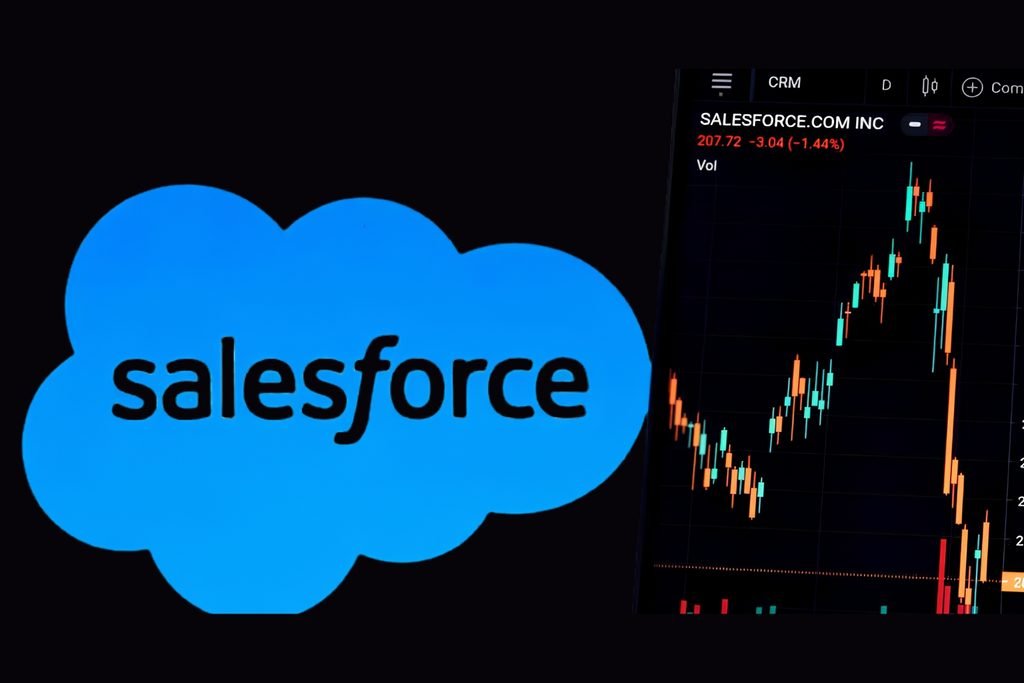
CRM Stock Falls Despite Salesforce having been making artificial intelligence a central part of its growth strategy, with Salesforce Agentforce, new AI models, and deeper partnerships with companies such as NVIDIA. Yet the CRM stock has continued to face pressure even as the company showcases new AI capabilities at Dreamforce 2026. On September 15, Salesforce shares closed at $255.65, down 1.46%, while the broader market also moved lower.
The latest AI announcement adds another important piece to Salesforce’s strategy: Koa, a CRM-focused reasoning model developed with NVIDIA and built on Nvidia Nemotron technology. So why isn’t the stock immediately responding more positively to these developments?
CRM Stock Falls Despite the AI Push?
One reason is that investors often look beyond product announcements and focus on whether new technology can translate into sustainable revenue and earnings growth.
Salesforce’s AI business has been expanding rapidly. According to recent reporting, Agentforce annual recurring revenue surpassed $1.5 billion, increasing more than 240% year over year. However, the stock’s performance has been much more modest over the same period.
This creates a gap between the company’s AI momentum and investor expectations. Salesforce needs to demonstrate that its AI investments can generate meaningful and repeatable financial growth rather than simply adding new features to its existing platform.
Recent market movements have also been influenced by broader concerns around technology valuations, interest rates, and the pace of AI development. Salesforce’s share price has therefore been moving within a wider market environment rather than responding only to individual AI announcements.
Salesforce Agentforce Is at the Center of the Strategy
Salesforce Agentforce is one of the company’s main efforts to turn generative AI into an enterprise product. The platform allows businesses to build and deploy AI agents that can work across Salesforce applications, Slack, and other platforms.
Salesforce has continued expanding Agentforce’s developer capabilities. Its 2026 updates include Agent Script and the new Agentforce Builder, giving organizations more control over how agents reason, interact with systems, and execute tasks.
The business model is also evolving. Salesforce is increasingly looking toward consumption-based pricing for AI agents, meaning revenue could increasingly depend on how extensively customers use these AI capabilities.
That creates an opportunity, but it also introduces uncertainty. Investors will want to see whether customers move from experimenting with AI agents to using them extensively in everyday business operations.
Nvidia Nemotron and Salesforce’s New Koa Model
One of the biggest announcements at Dreamforce 2026 was Koa, Salesforce’s first CRM reasoning model.
Salesforce developed Koa in collaboration with NVIDIA. The model was built by post-training Nvidia Nemotron 3 Super using a proprietary synthetic dataset designed around enterprise knowledge and CRM workflows. Salesforce says the model draws on 27 years of CRM intelligence without using customer data for its training.
Koa is designed to help AI agents handle complex, multistep enterprise tasks. Rather than relying entirely on general-purpose AI models, Salesforce is developing a model specifically suited to sales, marketing and customer-service workflows.
This could strengthen the capabilities of Salesforce Agentforce AI, particularly for companies that want AI systems capable of working with structured business processes and CRM information.
What Is Salesforce Hyperforce’s Role?
Another important part of Salesforce’s AI infrastructure is Salesforce Hyperforce.
Hyperforce is Salesforce’s cloud infrastructure architecture designed to support the company’s platform across different regions and cloud environments. As AI workloads become more demanding, infrastructure becomes increasingly important because AI agents need access to business data, applications, security controls and computing resources.
Salesforce’s AI strategy therefore isn’t only about building models. It also depends on the underlying infrastructure that allows those models and agents to operate securely at enterprise scale.
The combination of Hyperforce, Data 360 and Agentforce gives Salesforce a broader platform for connecting company data with AI-powered workflows.
Why AI Announcements Alone May Not Lift the Stock
A major challenge for Salesforce is that investors are likely to evaluate AI based on financial results rather than announcements alone.
The company has to answer several questions:
- How quickly will Agentforce adoption translate into revenue?
- How much will customers spend on AI agents?
- Can AI accelerate overall Salesforce growth?
- Will AI increase margins or require significant additional investment?
- Can Salesforce maintain its position as companies adopt general-purpose AI agents?
These questions matter because enterprise customers now have more AI options than they did a few years ago.
The emergence of increasingly capable general-purpose AI systems has also created uncertainty for traditional software companies. Investors have questioned whether AI agents could eventually reduce the need for some conventional software interfaces or seats.
Salesforce is attempting to address that challenge by making AI agents part of its own ecosystem rather than allowing external AI platforms to sit entirely outside it.
What Investors Will Be Watching Next
The next stage of Salesforce’s AI story will likely depend on execution.
The company needs to show that Salesforce Agentforce AI can move beyond demonstrations and become an important part of customers’ daily operations. Koa could help by providing specialized reasoning capabilities for CRM-related tasks, while Nvidia Nemotron gives Salesforce access to an open-model foundation for its development.
At the same time, Salesforce needs to demonstrate that its infrastructure, including Salesforce Hyperforce, can support these workloads efficiently and securely at enterprise scale.
The market will therefore be watching customer adoption, AI-related recurring revenue, pricing changes, margins and Salesforce’s broader revenue growth.
Conclusion: What the CRM Stock Movement Means
The recent weakness in CRM stock does not necessarily mean investors are dismissing Salesforce’s AI strategy. The share-price movement reflects a combination of broader market conditions, valuation concerns and questions about how quickly AI investments will translate into financial growth.
Salesforce’s launch of Koa, its partnership with NVIDIA and continued development of Salesforce Agentforce show that the company is investing heavily in specialized enterprise AI. Nvidia Nemotron provides the foundation for its new reasoning model, while Salesforce Hyperforce remains part of the infrastructure supporting its cloud platform.
For investors and businesses, the key question is no longer simply whether Salesforce is investing in AI. It is whether these AI investments can produce measurable, sustainable business results. That will likely be more important to the future direction of CRM stock than any single product announcement.