
Open-Source vs Commercial Agentic AI Platforms. Artificial intelligence has evolved far beyond chatbots and virtual assistants. Today, agentic AI platforms are enabling autonomous AI agents that can reason, plan, make decisions, and execute complex workflows with minimal human intervention. From automating customer support to streamlining software development and supply chain operations, businesses are rapidly adopting these platforms to improve productivity and reduce operational costs.
According to Gartner, by 2028, nearly 33% of enterprise software applications are expected to incorporate agentic AI, compared to less than 1% in 2024. Gartner also predicts that around 15% of day-to-day business decisions will be made autonomously through AI agents. These projections highlight why organizations are increasingly evaluating both open-source AI platforms and commercial AI platforms to determine which solution best fits their business goals.
But which option is the better choice? Should you invest in a highly customizable open-source framework, or choose a fully managed enterprise solution with built-in security, compliance, and support? This guide compares open-source vs. commercial agentic AI platforms based on features, costs, scalability, security, and enterprise readiness.
What Are Agentic AI Platforms?
Agentic AI platforms are software frameworks that enable organizations to build, deploy, and manage autonomous AI agents capable of performing multi-step tasks without continuous human guidance. Unlike traditional AI applications that respond only to prompts, agentic AI systems can plan, use external tools, collaborate with other agents, remember past interactions, and adapt their actions to changing conditions.
Modern AI agent frameworks integrate large language models (LLMs), APIs, databases, automation tools, and business applications into a unified ecosystem. As a result, enterprises can automate repetitive workflows, improve decision-making, and deliver more personalized customer experiences.
These platforms are becoming the foundation of enterprise AI automation, supporting industries such as healthcare, finance, manufacturing, logistics, retail, and software development.
What Are Open-Source Agentic AI Platforms?
Open-source AI platforms provide developers with publicly available frameworks for building and customizing AI agents to meet their specific business needs. Since the source code is accessible, organizations have complete control over deployment, integrations, and model selection.
Popular open-source AI agents and frameworks include:
CrewAI – Designed for collaborative multi-agent workflows where specialized AI agents work together to complete complex tasks.
LangGraph – Built on LangChain, enabling developers to create stateful and highly reliable AI workflows.
AutoGen – Developed by Microsoft Research to support conversations and collaboration between multiple AI agents.
Semantic Kernel – Microsoft’s open-source SDK for integrating AI into enterprise applications.
OpenAI Agents SDK – A flexible framework for developing intelligent AI agents using advanced language models.
Advantages of Open-Source Agentic AI Platforms
- High customization and flexibility
- No vendor lock-in
- Lower licensing costs
- Large developer communities
- Freedom to choose preferred AI models
- Better control over deployment environments
These platforms are particularly suitable for startups, research organizations, and businesses with experienced engineering teams capable of managing infrastructure and ongoing development.
Challenges
Despite their flexibility, open-source solutions often require the following:
- Dedicated technical expertise
- Infrastructure management
- Security configuration
- Continuous maintenance
- Manual compliance implementation
Organizations without skilled AI engineers may find deployment and maintenance more complex than expected.
What Are Commercial Agentic AI Platforms?
Commercial AI platforms provide fully managed environments for building and deploying AI agents with enterprise-grade security, governance, and support. Instead of managing infrastructure, organizations can focus on creating business workflows while the platform handles scalability, updates, monitoring, and compliance.
Leading commercial agentic AI platforms include the following:
- Microsoft Copilot Studio
- Google Vertex AI Agent Builder
- Amazon Bedrock Agents
- Salesforce Agent Force
- IBM watsonx
These enterprise AI platforms offer pre-built integrations with business applications, drag-and-drop workflow builders, monitoring dashboards, and advanced governance features that simplify AI deployment.
Advantages of Commercial AI Platforms
Commercial solutions are designed for organizations that prioritize speed, security, and reliability. Key benefits include the following:
- Enterprise-grade security and compliance
- Managed infrastructure
- Faster deployment
- Dedicated technical support
- Automatic updates
- Built-in monitoring and governance
- Seamless integration with enterprise software
These features make commercial platforms an attractive choice for large enterprises operating in regulated industries such as banking, healthcare, and government.
Limitations
While commercial platforms reduce operational complexity, they may involve:
- Higher subscription costs
- Limited customization compared to open-source frameworks
- Potential vendor lock-in
- Dependence on platform-specific ecosystems
For many enterprises, however, these trade-offs are outweighed by improved reliability, security, and faster time to value.
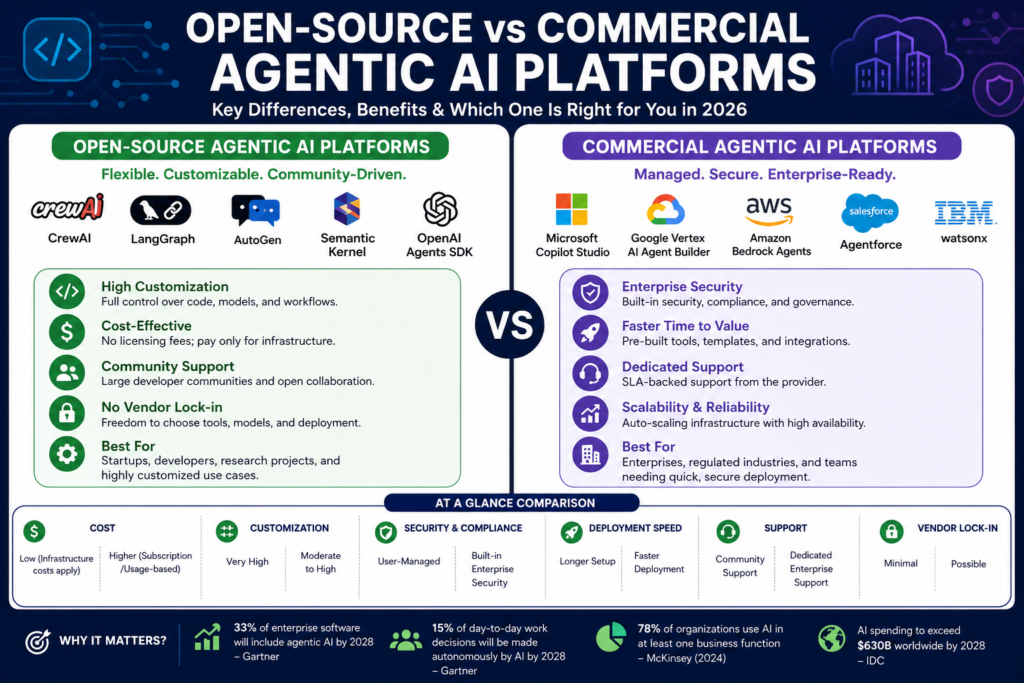
Open-Source vs Commercial Agentic AI Platforms: Side-by-Side Comparison
Choosing between open-source and commercial AI platforms depends on your organization’s technical expertise, budget, compliance requirements, and long-term AI strategy. Here’s a quick comparison:
| Feature | Open-Source Agentic AI Platforms | Commercial Agentic AI Platforms |
|---|---|---|
| Cost | Free or low licensing cost | Subscription or usage-based pricing |
| Customization | Very high | Moderate to high |
| Infrastructure | Self-managed | Fully managed |
| Security | User-managed | Enterprise-grade security built in |
| Compliance | Requires manual implementation | Built-in support for standards like SOC 2, GDPR, and HIPAA |
| Technical Support | Community support | Dedicated enterprise support |
| Deployment Speed | Longer setup time | Faster deployment |
| Scalability | Depends on infrastructure | Automatic cloud scalability |
| Vendor Lock-in | Minimal | Possible depending on the provider |
For organizations with strong development teams, open-source AI platforms offer unmatched flexibility. However, businesses that require enterprise-grade governance and compliance, as well as rapid implementation, often benefit more from commercial Agentic AI platforms.
Which Platform Is Right for Your Business?
The right Agentic AI platform depends on your business goals and available resources.
Choose Open-Source AI Platforms If You:
- Have an experienced AI or software engineering team.
- Need complete control over AI models and workflows.
- Want to avoid vendor lock-in.
- Require extensive customization.
- Are building innovative or research-focused AI applications.
Choose Commercial AI Platforms If You:
Need faster deployment with minimal infrastructure management.
Operate in regulated industries such as healthcare, finance, or government.
Require enterprise-grade security and compliance.
Want dedicated technical support and service-level agreements (SLAs).
Need seamless integration with existing cloud and business applications.
Security, Compliance, and Governance
Security is one of the biggest differentiators between open-source and commercial platforms.
While open-source frameworks can be highly secure, organizations are responsible for configuring authentication, encryption, access controls, monitoring, and compliance. This requires ongoing expertise and maintenance.
Commercial enterprise AI platforms typically include:
- Role-Based Access Control (RBAC)
- Encryption for data at rest and in transit
- Audit logs and monitoring
- Identity and Access Management (IAM)
- Compliance certifications such as SOC 2, GDPR, HIPAA, and ISO 27001
- Built-in AI governance and policy management
These capabilities make commercial solutions particularly attractive for enterprises handling sensitive customer or business data.
Latest Industry Trends Driving Agentic AI Adoption
The adoption of Agentic AI platforms is accelerating across industries.
Recent industry reports highlight this growth:
Gartner predicts that 33% of enterprise software applications will include agentic AI by 2028, compared to less than 1% in 2024. Additionally, 15% of day-to-day work decisions are expected to be made autonomously by AI agents.
McKinsey & Company reports that 78% of organizations use AI in at least one business function, reflecting the rapid expansion of AI-powered automation.
IDC forecasts that worldwide spending on AI technologies will exceed $630 billion by 2028, driven by investments in generative AI, intelligent automation, and enterprise AI infrastructure.
These trends indicate that organizations are shifting from AI experimentation to deploying production-ready AI agent software that delivers measurable business value.
The Future of Agentic AI Platforms
As AI technology matures, the next generation of agentic AI platforms will focus on the following:
- Multi-agent collaboration for solving complex business tasks.
- AI orchestration platforms that connect multiple enterprise systems.
- No-code and low-code AI agent builders for business users.
- Stronger AI governance, transparency, and compliance.
- Industry-specific AI agents for healthcare, finance, retail, and manufacturing.
- Hybrid deployments that combine cloud and on-premises environments for enhanced security and flexibility.
Organizations that invest in scalable and secure AI workflow automation today will be better positioned to adapt to these future innovations.
Conclusion
Open-source vs. commercial Agentic AI platforms offer significant advantages, but the best choice depends on your organization’s goals, technical capabilities, and compliance requirements. Open-source frameworks excel in flexibility, customization, and innovation, making them ideal for development-driven teams. Commercial platforms, on the other hand, simplify deployment with enterprise-grade security, governance, and support, helping businesses scale AI initiatives faster.
As Agentic AI, AI workflow automation, and enterprise AI platforms continue to evolve, selecting the right platform will become a strategic decision that influences operational efficiency, customer experience, and long-term digital transformation. Evaluating your business needs today will help you build a future-ready AI ecosystem.
FAQs
1. What is an Agentic AI platform?
An agentic AI platform enables businesses to build, deploy, and manage autonomous AI agents that can reason, plan, and execute tasks with minimal human intervention.
2. Are open-source Agentic AI platforms free?
Most open-source platforms are free to use, but organizations should consider the costs of infrastructure, maintenance, and engineering resources.
3. Which is the best open-source Agentic AI framework?
Popular options include CrewAI, LangGraph, AutoGen, Semantic Kernel, and the OpenAI Agents SDK. The best choice depends on your use case and development requirements.
4. Are commercial AI platforms more secure?
Commercial platforms typically provide built-in enterprise security, compliance certifications, governance tools, and dedicated support, making them suitable for regulated industries.
5. Which platform is better for enterprises?
Large enterprises often prefer commercial AI platforms because they offer managed infrastructure, enterprise integrations, and compliance features. Organizations with specialized AI teams and unique requirements may benefit more from open-source solutions.
What’s up Dear, are you actually visiting this site regularly, if so afterward you will definitely
take good know-how.