
The Evolution of AI From Chatbots to Agentic AI Platforms. Over the past ten years, artificial intelligence (AI) has advanced quickly, altering how people use technology and how businesses function. These days, sophisticated agentic AI platforms that can reason, plan, make decisions, and carry out difficult tasks with little assistance from humans have evolved from basic rule-based chatbots that could only respond to predetermined questions.
These days, businesses are shifting from conversational AI to autonomous systems that boost output, simplify processes, and allow for intelligent business automation. AI is evolving from a mere productivity tool to a strategic business asset in a variety of industries, including supply chain management, software development, customer service, and finance.
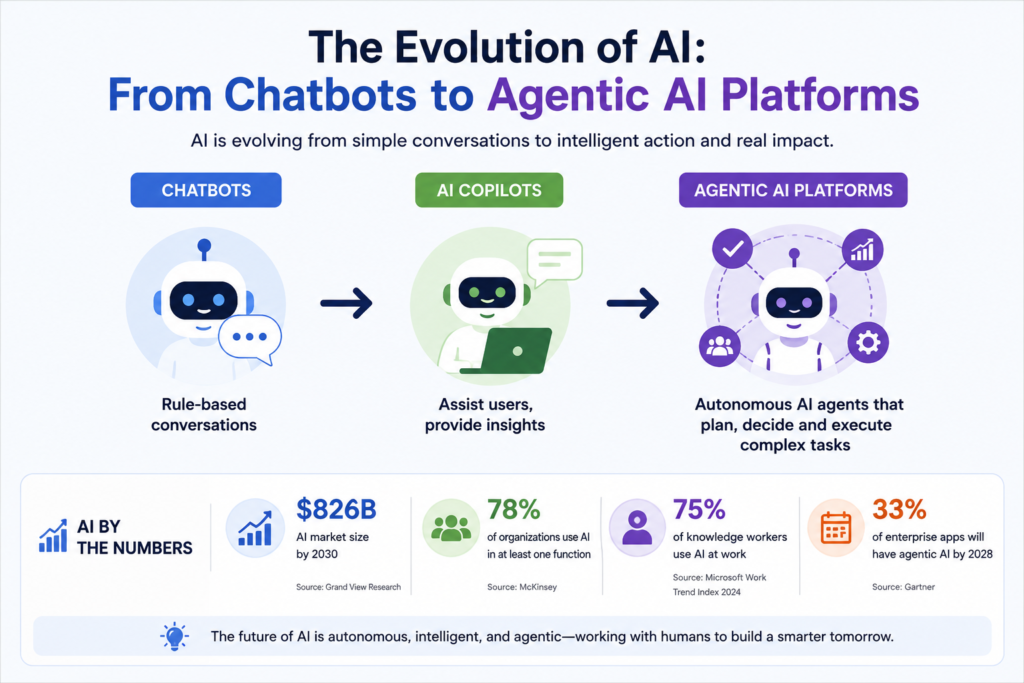
Grand View Research projects that the global artificial intelligence market will grow at a compound annual growth rate (CAGR) of more than 27% and surpass $826 billion by 2030. This impressive expansion is a reflection of the growing need for enterprise AI systems that can manage intricate processes and produce quantifiable business results.
The development of AI, how agentic AI platforms vary from conventional chatbots, and why they are the way of the future for business automation will all be discussed in this article.
What Is Artificial Intelligence?
Artificial intelligence is the term used to describe computer programs created to carry out tasks like learning, reasoning, problem-solving, language comprehension, and decision-making that normally require human intelligence.
Modern AI combines multiple technologies, including
- Machine Learning (ML)
- Deep Learning
- Natural Language Processing (NLP)
- Large Language Models (LLMs)
- Computer Vision
- Reinforcement Learning
These technologies allow AI systems to continuously improve their performance by learning from data and user interactions.
AI now powers everything from virtual assistants and self-driving cars to fraud detection systems and recommendation engines.
The Early Days of Rule-Based Chatbots
The initial generation of AI-driven chatbots relied on prewritten responses and predetermined rules. Only questions that they had been specifically programmed to recognize could be answered by these systems.
Early chatbots had the following traits:
- Matching keywords
- Limited conversation flow
- Lack of contextual awareness
- Between interactions, there is no memory
- incapacity to carry out difficult tasks
These chatbots were helpful in reducing customer service workloads and providing answers to frequently asked questions, but they lacked intelligence and flexibility.
Companies soon discovered that rule-based systems were unable to grow with the demands of their expanding clientele.
How Generative AI Changed Human-AI Interaction
An important development in artificial intelligence was the introduction of generative AI.
Large language models (LLMs) enable generative AI to comprehend natural language, produce human-like text, summarize documents, write code, analyze data, and assist with creative tasks.
Unlike traditional chatbots, generative AI can:
- Understand context
- Maintain longer conversations
- Generate original content
- Answer complex questions
- Assist with research and analysis
This change turned AI from a reactive tool into an intelligent assistant that can help knowledge workers in a variety of industries.
75% of knowledge workers now use AI tools in their daily work, according to Microsoft’s Work Trend Index, indicating how quickly AI has permeated contemporary business operations.
What Is an Agentic AI Platform?
The next phase of artificial intelligence development is an agentic AI platform. The next phase of artificial intelligence development is an agentic AI platform.
Agentic AI systems are capable of independent planning, reasoning, task execution, outcome monitoring, and behavioral adaptation in response to changing circumstances, rather than merely reacting to prompts.
These platforms combine:
- Large Language Models (LLMs)
- AI agents
- Workflow orchestration
- Memory systems
- External tool integration
- Autonomous decision-making
An agentic AI platform can break down goals into smaller tasks, coordinate multiple AI agents, access business applications, retrieve relevant information, and complete workflows with minimal supervision, rather than waiting for constant user instructions.
For instance, an agentic AI platform can do more than just respond to a customer’s query.
- Check the customer’s details
- Obtain account information
- Handle reimbursements
- Update CRM records
- Inform the appropriate teams
- Produce reports
All of this can happen automatically through intelligent workflow automation.
Chatbots vs AI Copilots vs Agentic AI Platforms
The evolution of AI can be understood by comparing these three stages.
Traditional Chatbots
- Follow predefined scripts
- Limited understanding
- Reactive responses
- No independent reasoning
- Suitable for FAQs
AI Copilots
- Assist users with content generation
- Suggest actions
- Summarize information
- Require continuous human guidance
- Improve productivity
Agentic AI Platforms
- Perform autonomous planning
- Execute multi-step workflows
- Collaborate through multiple AI agents
- Learn from previous interactions
- Integrate with enterprise systems
- Make intelligent decisions within defined boundaries
This progression highlights how AI is evolving from a conversational interface to an autonomous digital workforce.
Key Technologies Behind The Evolution From Chatbot to Agentic AI
Several advanced technologies enable modern agentic AI platforms.
Large Language Models (LLMs)
LLMs provide reasoning, language understanding, and knowledge generation capabilities.
AI Agents
AI agents specialize in individual tasks, such as research, coding, scheduling, customer support, or data analysis.
Multi-Agent AI Systems
Multiple AI agents collaborate to solve complex business problems more efficiently than a single AI model.
Retrieval-Augmented Generation (RAG)
RAG enables AI systems to retrieve accurate, up-to-date information from enterprise knowledge bases before generating responses, improving factual accuracy.
Workflow Automation
AI integrates with enterprise applications like CRM, ERP, HR, and project management software to automate repetitive business processes.
Memory and Context
Persistent memory allows AI agents to remember previous interactions, enabling more personalized and context-aware responses over time.
Real-World Applications of Agentic AI Platforms
Organizations across industries are already deploying enterprise AI platforms to automate complex business operations.
Customer Support
AI agents resolve support tickets, process returns, escalate issues, and provide personalized assistance.
Healthcare
AI assists with patient scheduling, medical documentation, clinical decision support, and administrative automation.
Software Development
Agentic AI helps generate code, identify bugs, perform testing, review pull requests, and automate documentation.
Finance
Financial institutions use AI-powered automation for fraud detection, compliance monitoring, invoice processing, and risk assessment.
Supply Chain
AI optimizes inventory management, demand forecasting, procurement, logistics planning, and warehouse operations.
Human Resources
Organizations automate resume screening, interview scheduling, employee onboarding, and internal knowledge management.
Benefits of Agentic AI for Enterprises
Businesses adopting agentic AI platforms gain several competitive advantages.
Increased Productivity
AI automates repetitive tasks, allowing employees to focus on higher-value strategic work.
Faster Decision-Making
Real-time data analysis helps organizations make informed decisions quickly.
Lower Operational Costs
Automation reduces manual effort and minimizes costly human errors.
Improved Customer Experience
AI provides faster, more personalized, and consistent customer interactions.
Scalability
AI agents can handle thousands of simultaneous workflows without compromising quality.
Continuous Learning
Unlike traditional software, AI systems improve over time by learning from new data and interactions.
According to McKinsey’s State of AI, 78% of organizations now use AI in at least one business function, demonstrating the growing importance of enterprise AI adoption.
Challenges and Risks of Autonomous AI
Despite its advantages, agentic AI presents several challenges.
Data Privacy
Organizations must ensure that sensitive business information remains secure.
AI Hallucinations
Large language models may occasionally generate inaccurate or fabricated information, making human oversight important for high-stakes tasks.
Governance
Clear policies are needed to define how AI agents make decisions and access enterprise systems.
Ethical Concerns
Businesses should implement responsible AI practices to ensure fairness, transparency, and accountability.
Regulatory Compliance
Organizations must comply with evolving AI regulations related to privacy, security, and risk management.
Addressing these challenges is essential for building trust and ensuring responsible AI adoption.
The Future of AI: Autonomous Multi-Agent Systems
The future of AI extends beyond individual assistants toward intelligent ecosystems of collaborating AI agents.
According to industry analysts, autonomous systems will increasingly oversee departmental business operations, coordinating tasks with minimal human assistance.
Gartner predicts that by 2028, agentic AI capabilities will be present in at least 33% of enterprise software applications, allowing autonomous decision-making in an increasing number of routine business processes.
Agentic AI platforms in the future will probably:
- Organize several AI agents from different companies.
- Optimize business processes continuously.
- Gain real-time insight from enterprise knowledge.
- Instead of replacing human workers, work together with them.
- Provide extremely customized experiences for both customers and staff.
Businesses that responsibly adopt agentic AI will be better positioned to innovate, increase productivity, and stay competitive as these technologies develop.
Final Thoughts
Artificial intelligence has come a long way from simple rule-based chatbots. The emergence of agentic AI platforms marks a fundamental shift from reactive conversational systems to autonomous digital collaborators capable of planning, reasoning, and executing complex workflows.
While chatbots have transformed customer communication and generative AI has enhanced human creativity, agentic AI is redefining enterprise automation by integrating multi-agent cooperation, AI-driven workflow automation, and intelligent decision-making.
Businesses that invest in enterprise AI platforms now are building the groundwork for the next wave of intelligent business operations, not merely implementing a new technology. Businesses that prioritize innovation, governance, and responsible implementation will be best positioned to realize the full potential of AI as it evolves.
Frequently Asked Questions
1. What is an agentic AI platform?
An agentic AI platform is an AI system that, with little human assistance, can autonomously plan, reason, and carry out multi-step tasks using autonomous AI agents.
2. How is agentic AI different from traditional chatbots?
While agentic AI platforms can make decisions, use tools, work with other AI agents, and finish complex workflows on their own, traditional chatbots only answer predetermined questions.
3. What industries benefit most from agentic AI?
Among the sectors that greatly benefit from agentic AI are healthcare, finance, retail, manufacturing, software development, customer service, logistics, and human resources.
4. Why are enterprises adopting agentic AI platforms?
Agentic AI platforms are used by businesses to automate repetitive tasks, increase productivity, reduce operating costs, improve customer experiences, and accelerate decision-making.
5. What is the future of agentic AI?
Autonomous multi-agent systems that work with people, streamline business processes, and provide intelligent, comprehensive business automation across industries are the future.
Pingback: Open-Source vs Commercial Agentic AI Platforms - Trendrixa