
NVIDIA and KAIST launch a collaborative AI research lab to promote agentic AI in Korea. Artificial intelligence is developing quickly, and developing more intelligent chatbots won’t be the next big thing. Agentic AI systems that can plan, think, and complete complex tasks with minimal human assistance are becoming increasingly important. A joint AI research lab has been established in South Korea by NVIDIA and the Korea Advanced Institute of Science and Technology (KAIST) in recognition of this opportunity.
There is more to the partnership than just a university and a technology company working together. It is a long-term investment in enterprise innovation, talent development, and AI research. The initiative aims to accelerate the development of next-generation AI systems and strengthen South Korea’s position as a global leader in AI by combining KAIST’s research expertise with NVIDIA’s world-leading AI infrastructure.
NVIDIA and KAIST launch AI Research in South Korea
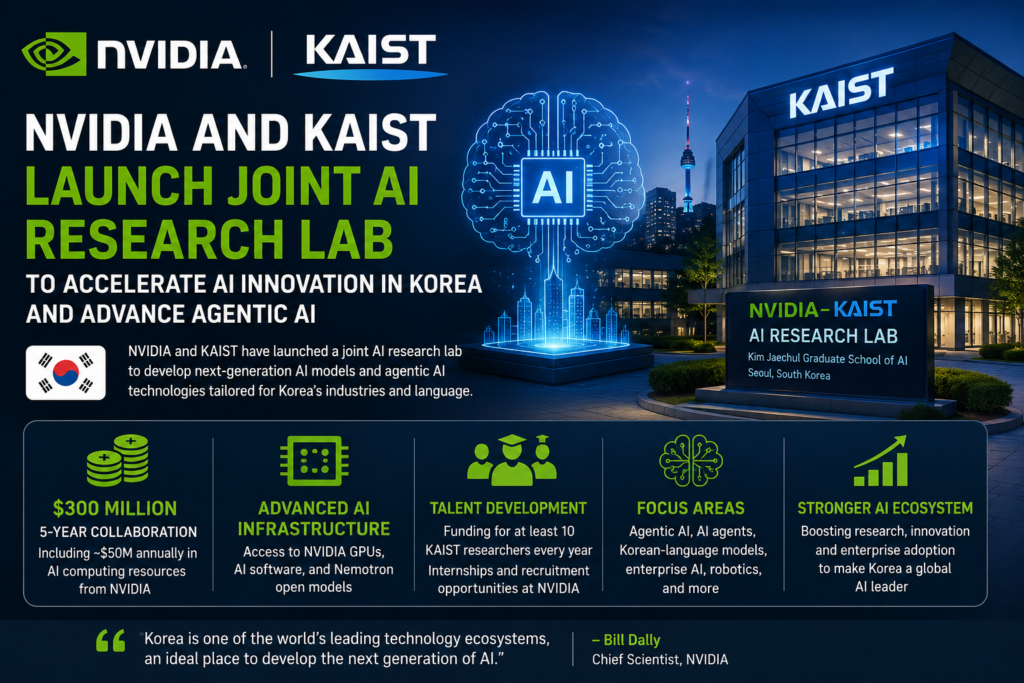
Located at the KAIST Kim Jaechul Graduate School of AI, the new NVIDIA-KAIST Joint AI Research Lab will concentrate on creating cutting-edge AI technologies that address practical issues.
The lab will focus on real-world AI solutions that businesses and industries can use, rather than just academic projects. Among its main research areas are:
- Agentic AI systems
- Korean-language AI models
- Enterprise AI applications
- AI agents for automation
- Industry-focused AI research
This practical approach ensures that new AI technologies move beyond research papers and into tools that businesses can use to boost productivity and decision-making.
Why This Partnership Matters
South Korea has already established itself as one of the world’s most advanced technology hubs, with multinational corporations like Samsung, SK Hynix, and LG driving innovation. As artificial intelligence becomes more prevalent in all industries, the country is investing heavily in research to maintain its global competitiveness.
This collaboration provides KAIST researchers with direct access to NVIDIA’s cutting-edge AI computing platforms and software, making it easier to train large AI models that would otherwise require massive computational resources.
For NVIDIA, collaborating with one of Asia’s leading research universities provides an opportunity to develop AI technologies that better understand Korean language, culture, and industry needs.
A Significant Investment in Korea’s AI Future
One of the biggest highlights of the partnership is its scale.
The collaboration includes an initial five-year commitment worth approximately $300 million, with NVIDIA contributing around $50 million per year in AI computing resources. This grants researchers access to a powerful GPU infrastructure capable of training advanced AI models.
The program also includes:
- Research funding for at least 10 KAIST researchers every year
- Internship opportunities at NVIDIA
- Career pathways into NVIDIA Research
- Access to NVIDIA’s AI software and open AI models
These initiatives not only support research but also help students gain valuable industry experience while working on real AI projects.
The Growing Importance of Agentic AI
While generative AI has transformed the way people create text, images, and code, agentic AI is expected to drive the next wave of innovation.
Unlike traditional AI models that respond to prompts, AI agents can complete multi-step tasks on their own. They can analyze data, make decisions, use software tools, and adjust their actions in response to changing circumstances.
Consider an AI assistant that not only answers questions but also schedules meetings, conducts research, prepares reports, and follows up on tasks without constant human supervision.
This is exactly the kind of technology NVIDIA and KAIST hope to advance with their new research lab.
AI That Understands Korea
Many of today’s large language models are primarily trained using English-language data. Although they support a variety of languages, they frequently struggle with local terminology, regulations, and cultural differences.
The NVIDIA-KAIST collaboration aims to change that by developing AI systems specifically for South Korea.
Researchers will focus on creating AI models that better understand:
- Korean language
- Local industries
- Manufacturing processes
- Public services
- Healthcare
- Robotics
- Semiconductor technologies
This localized approach will make AI solutions more accurate and useful for Korean businesses and government organizations.
Creating Opportunities for Future AI Talent
Beyond research, the collaboration focuses on developing future AI experts.
Every year, selected KAIST researchers will receive funding, collaborate with NVIDIA engineers, and take part in internship programs. Outstanding researchers may be able to join NVIDIA Research after completing their studies.
This type of industry-academic collaboration allows students to gain hands-on experience while also providing NVIDIA with access to some of the region’s top AI talent.
For aspiring AI researchers, it provides an opportunity to work with cutting-edge technology while addressing real-world problems.
What This Means for Businesses
The collaboration benefits both researchers and businesses.
Companies in manufacturing, finance, healthcare, retail, and logistics are increasingly looking for AI solutions to automate workflows and boost efficiency. However, many organizations require AI systems that understand local languages, regulations, and business environments.
By creating AI models tailored to South Korea, the NVIDIA-KAIST lab hopes to help businesses adopt AI more quickly and effectively.
Businesses may eventually benefit from AI agents that can streamline operations, improve customer experiences, support decision-making, and automate repetitive tasks with greater accuracy.
NVIDIA and KAIST South Korea’s AI Ecosystem
The establishment of the research lab reflects South Korea’s larger ambition to become a global AI powerhouse.
By bringing together academia, industry, and advanced computing infrastructure, the collaboration fosters an environment in which innovative ideas can quickly transition from research to commercial applications.
Rather than relying solely on AI technologies developed elsewhere, South Korea is investing in domestic AI capabilities that can support its industries and boost its long-term competitiveness.
This approach is consistent with the growing global focus on sovereign AI, in which countries create AI systems tailored to their specific languages, economies, and strategic priorities.
Final Thoughts
The establishment of the NVIDIA-KAIST Joint AI Research Lab represents an exciting step forward for both South Korea and the global AI community.
By combining NVIDIA’s powerful AI infrastructure with KAIST’s research expertise, the partnership fosters an environment in which innovative ideas can be turned into viable AI solutions. From advancing Agentic AI and enterprise AI to developing future AI talent, the initiative has the potential to shape how AI is developed and used for many years to come.
As organizations increasingly use AI to solve complex business challenges, collaborations like this demonstrate that the future of artificial intelligence is more than just building smarter models; it is about creating intelligent systems that can collaborate with people, understand local needs, and drive meaningful innovation across industries.
FAQs
1. What is the NVIDIA-KAIST Joint AI Research Lab?
It is a collaborative AI research center established by NVIDIA and KAIST to develop next-generation AI technologies and Agentic AI systems.
2. Why did NVIDIA partner with KAIST?
NVIDIA partnered with KAIST to accelerate AI innovation, support AI research, and develop advanced AI solutions tailored for South Korea.
3. What is Agentic AI?
Agentic AI refers to AI systems that can plan, reason, and complete multi-step tasks with minimal human intervention.
4. How will this partnership benefit South Korea?
The collaboration will strengthen Korea’s AI ecosystem by advancing research, developing AI talent, and supporting enterprise AI adoption.
5. Which industries could benefit from this AI research lab?
Industries such as manufacturing, healthcare, finance, robotics, and semiconductors are expected to benefit from the lab’s AI innovations.
Pingback: HCLTech Announces Investment of ₹14,257 Cr AI Data Centre -