
Understand why investors are going through massive liquidation of NVIDIA Corporation (NASDAQ: NVDA) shares is driven by three distinct groups: corporate insiders, high-profile billionaire hedge fund managers, and institutional hedge funds.
According to global prime brokerage data from major investment banks like Goldman Sachs, institutional funds scaled back their semiconductor exposure at the fastest rate in over a decade. While Nvidia’s fundamentals remain robust, a mixture of valuation concerns, automated selling plans, and a rotation into custom silicon has prompted the largest stakeholders to lock in profits.
Major institutional investors, prominent hedge funds, and prominent billionaires have sold or reduced significant portions of their NVIDIA (NVDA) stock holdings, citing high valuations and concerns about an artificial intelligence market bubble.
Key Investors Who Sold or Reduced NVIDIA Stock
Corporate Insiders Cash Out Billion-Dollar Stakes
According to compiled SEC Form 4 filings, Nvidia executives and board members have capitalized on the stock’s historic highs by executing substantial open-market sales.
- Mark A. Stevens (Director): As a venture capitalist and Nvidia’s second-largest individual shareholder, Stevens topped the list of global AI insider sellers. In Q3 2026, he offloaded 4.24 million shares, cashing out an astounding $946.6 million through a series of trust liquidations. Stevens completed additional massive blocks in September alone.
- Executive Leadership Team: General Counsel Timothy Teter liquidated over $13.3 million in shares across late August and September 2026. Chief Financial Officer Colette Kress also pared back a portion of her vested equity incentive awards.
- CEO Signaling: Notably, founder and CEO Jensen Huang has refrained from making open-market sales during this volatile autumn window, providing a baseline signal of stability for long-term holders.
- Peter Thiel (Thiel Macro LLC): Exited his entire NVIDIA stake of 537,742 shares (valued at roughly $100 million). He later completely cleared remaining stock positions as part of a shift toward cash and other tech giants.
- SoftBank: Liquidated its entire NVIDIA stake to free up capital for investments in OpenAI.
- Michael Burry (Scion Asset Management): Opened a short position against NVIDIA valued at $186 million.
- Israel Englander (Millennium Management): Sold 3,038,895 shares.
- Chase Coleman (Tiger Global Management): Sold 698,000 shares.
- Philippe Laffont (Coatue Management): Sold 667,405 shares.
- David Tepper (Appaloosa Management): Sold 200,000 shares.
Institutional Capital Trims Semiconductor Concentration
The broader institutional layer shows highly mixed sentiment. While defensive tech giants like BlackRock and Vanguard maintain massive index-weighted holdings, active hedge funds have net-sold chip stocks to mitigate strict concentration risks.
According to Morgan Stanley’s latest sector metrics, an astonishing 91.7% of Nvidia’s fiscal revenue is directly exposed to pure AI infrastructure demand. This hyper-concentration has prompted active managers to diversify. While select managers like Tiger Global selectively added blocks earlier in the cycle, the broader trend among active funds has shifted toward scaling down semiconductor exposure in favor of defensive cash positions and the utility sector.
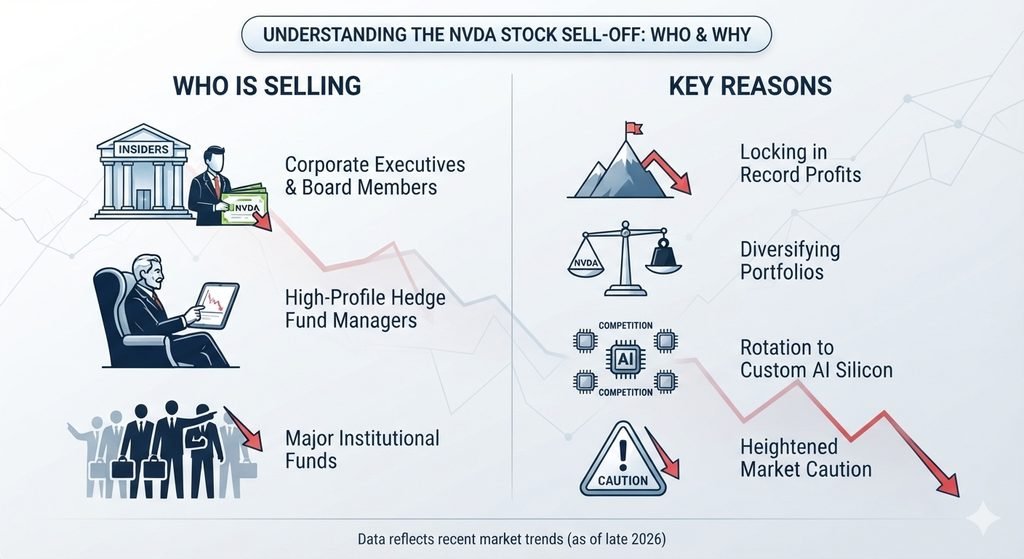
Core Catalysts Fueling the Nvidia Sell-Off
The decision to dump Nvidia stock is tightly linked to structural vulnerabilities appearing within the AI supply chain:
| Catalyst | Economic Impact & Market Reality |
|---|---|
| The AI “Credit Wall” | Prominent AI cloud architecture firms like CoreWeave and Nebius have watched their bond yields surge to 15%. Higher borrowing costs make financing new data center expansions prohibitively expensive, directly threatening Nvidia’s pipeline. |
| In-House Custom Silicon | Major hyper-scalers—including Amazon, Google, and Microsoft—are aggressively rolling out proprietary internal processors (Trainium, TPUs, and Maia), cutting deep into long-term third-party GPU demand. |
| CapEx Impairment Warnings | Tech research firm Gartner issued a warning projecting that up to $3.5 trillion in AI infrastructure capital expenditure could face heavy impairment by 2030, driving institutional anxiety over a structural tech bubble. |
Why They Are Selling
- Bubble Concerns: Investors like Peter Thiel have publicly compared the current AI infrastructure wave to the late-1990s dot-com bubble.
- Uncertain Return on Investment: Critics point to massive data center spending by tech giants that lacks a guaranteed short-term payoff.
- Rising Competition: Alternative chipmakers like AMD and custom in-house AI silicon from major clients (such as Google, Microsoft, and Meta via Broadcom) threaten NVIDIA’s market dominance.
Profit-Taking: Many major funds are locking in massive gains following NVIDIA’s Many major funds are locking in massive gains following NVIDIA’s multi-year historic stock rally.
Despite the dramatic sell-off, underlying hardware manufacturing firms like ASML note that high-end equipment capacity remains effectively sold out for years. However, until corporate hyperscalers prove that their massive AI infrastructure builds can generate robust, independent free cash flow, the market’s elite players are locking in multi-billion dollar profits.