
An agentic AI platform refers to artificial intelligence systems that can plan, reason, make decisions, and act autonomously to achieve goals with minimal human intervention. Unlike traditional AI tools, which respond to individual prompts, agentic AI systems operate continuously, assume ongoing responsibilities, and make decisions within predefined boundaries. Agentic AI represents a fundamental shift for organizations: from using AI as a tool to integrating AI as a team member. And, like any team member, an AI agent requires a defined role, explicit accountability, and governance that evolves as the organization learns.
What Is an Agentic AI Platform?
Agentic AI platform is an artificial intelligence system that can complete a specific task with minimal supervision. It is made up of AI agents and machine learning models that simulate human decision-making to solve problems in real time. In a multi-agent system, each agent performs a specific subtask necessary to achieve the goal, and their efforts are coordinated using AI orchestration.
Unlike traditional AI models, which operate within predefined constraints and require human intervention, agentic AI is autonomous, goal-driven, and adaptable. The term “agentic” refers to these models’ agency, or the ability to act independently and purposefully.
How Agentic AI Platform Works: Core Mechanisms
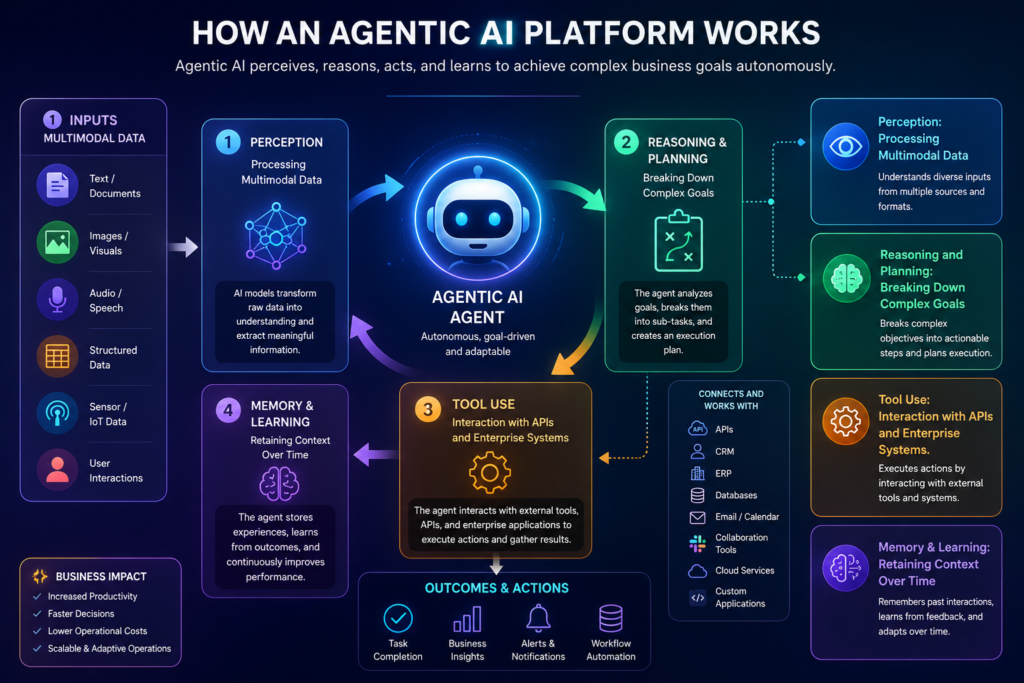
The effectiveness of agentic AI stems from a cycle of perception, reasoning, action, and memory. Unlike a static chatbot, which simply responds to a prompt, an agentic system employs these four mechanisms to navigate complex environments and complete multi-step workflows.
Perception: Processing Multimodal Data.
Perception is the agent’s ability to “see” and “sense” its environment, allowing it to dynamically interpret context.
Multimodal Inputs: Unlike traditional automation, which relies on structured data (spreadsheets), agentic AI processes unstructured multimodal inputs such as text, voice, images, and screen context simultaneously.
Contextual Understanding: The system uses Natural Language Processing (NLP) to analyze not only the words spoken but also the situation, user history, and emotional cues. Agentic AI can optimize processes by combining insights from sales, inventory, and shipping to improve efficiency and forecasting.
Attention mechanisms in deep learning models enable the agent to focus on specific, relevant parts of the input data (for example, a critical clause in a contract) rather than processing everything in isolation.
Reasoning and Planning: Breaking Down Complex Goals
AI reasoning serves as the system’s “brain” and is typically powered by large language models. Instead of jumping to conclusions, the agent employs advanced logic to break down a high-level goal into a step-by-step strategy.
AI reasoning serves as the system’s “brain” and is typically powered by large language models. Instead of jumping to conclusions, the agent employs advanced logic to break down a high-level goal into a step-by-step strategy.
Task Decomposition: The agent divides a complex goal (e.g., “Optimizing supply chain logic”) into manageable subtasks (predict demand, check inventory, identify bottlenecks, and contact suppliers).
Decision-Making Frameworks: Agentic AI systems use machine learning algorithms to perform advanced reasoning, planning, and decision-making, enabling them to learn from data and take autonomous actions.
Probabilistic Models: The agent evaluates the likelihood of different outcomes to make informed decisions in uncertain environments.
Chain-of-Thought (CoT) Reasoning: The agent “thinks” through the problem, evaluating various options before deciding on the best course of action to avoid issues like shipping delays.
Tool Use: Interaction with APIs and Enterprise Systems.
Reasoning is ineffective without the ability to act. This mechanism closes the gap between “knowing” and “doing.”
API Integration: Agentic AI communicates with external tools (ERP, CRM, email clients) using secure APIs. It can not only read data, but also write it, trigger transactions, and update records.
Agentic AI goes beyond isolated reasoning by connecting to external AI systems and software using Agent2Agent (A2A) protocols. This interoperability enables agents to access diverse data sources and make complex decisions across distributed environments.
Autonomous Execution: If a return is eligible, the agent can generate a shipping label and email it to the customer without requiring human intervention.
Rule-Based Guardrails: While autonomous, these actions frequently follow predefined rules to ensure safety (for example, “Approvals over $10,000 require human sign-off”).
Memory & Learning: Retaining Context Over Time
To avoid making the same mistakes, agentic AI employs advanced memory architectures that retain context and learn from experience. Advanced memory systems enable AI agents to retain context from ongoing conversations while adapting and optimizing their actions through continuous learning and interaction with external tools. Access to previous interactions enables agentic AI to provide more personalized and effective responses by allowing agents to better understand user preferences and intentions.
Short-Term Memory (Context Window): Remembers information from the current session (e.g., a customer asked about “returns” two minutes ago).
Long-Term Memory (Vector Databases): Retains historical interactions and outcomes. This allows the agent to recall past preferences or supply chain disruptions that occurred months ago.
Reinforcement Learning: The agent constantly refines its strategy based on feedback (rewards or penalties). If a specific vendor response strategy failed previously, the agent adapts its approach in future interactions to maximize success.
Reinforcement Learning: The agent constantly refines its strategy based on feedback (rewards or penalties). If a specific vendor response strategy failed the previous time, the agent adapts its approach for future interactions to maximize success.
Benefits of Agentic AI for Businesses
Agentic AI enables organizations to achieve previously considered aspirational levels of efficiency and scalability. Businesses can respond instantly to changing conditions by empowering AI capabilities to manage complex workflows and tasks autonomously, allowing employees to focus on high-value innovation.
Moving Beyond Efficiency to Autonomy.
Traditional automation accelerates work, but Agentic AI fundamentally alters how work is completed. It progresses from simple task execution to fully autonomous operation. The ability to manage complex workflows with flexibility is a significant advantage.
For example, in supply chain management, an agentic system does more than just execute a pre-programmed order; it analyzes data from multiple sources to forecast demand and identify bottlenecks before they occur.
This shift allows for quick response and adaptability. A distinguishing feature of agentic AI is its ability to interpret real-time data and recalibrate actions, such as adjusting delivery schedules due to shipping delays, without requiring constant human intervention.
Agentic AI achieves agility that static automation cannot match by combining real-time responsiveness and self-learning.
Cost Reduction and ROI Velocity
Agentic AI’s ability to self-learn and optimize processes over time leads to increased performance scalability and faster ROI. As operational demands grow, traditional systems frequently necessitate costly manual upgrades or human intervention.
Agentic AI, on the other hand, uses cloud platforms and LLMs to scale seamlessly, allowing for increased workloads without sacrificing performance or incurring linear cost increases.
Furthermore, by automating repetitive cognitive tasks such as scheduling and routine customer inquiries, businesses can significantly reduce operational overhead. This not only reduces the costs associated with manual errors and reprogramming, but it also accelerates value creation.
Employees are free to focus on creative problem-solving and strategic activities, resulting in innovation that directly benefits the bottom line.